MHD interaction in the boundary layer of hypersonic flows
The concept of hypersonic flight has recently received an increasing interest. Hypersonic flight has been usually linked to the re-entering of space vehicles in the atmosphere. A new wide range of applications of hypersonic flight is related to the development of a single stage to orbit (SSTO) vehicle, that is now one of the main prerequisite for the commercial exploitation of space flight. An SSTO vehicle should be powered by air breathing engines: a turbojet for low speed operations, such as take off and landing, a ramjet for vehicle Mach numbers between 4 and 7, and finally a scramjet that could accelerate the vehicle up to Mach 20 in the upper layers of the earth atmosphere. Many applications of the MHD interaction in hypersonic vehicle has been proposed and discussed. An MHD system has been proposed to control the fluid dynamics at the inlet of the scramjet; the Russian AJAX project, MHD techniques are utilized to bypass kinetic energy of the working fluid from the supersonic diffuser to the nozzle, reducing the flow velocity in the combustion chamber to acceptable value, even for high vehicle Mach numbers.
A model for the analysis of the magneto-plasmadynamic regime, devoted to MHD systems in a hypersonic flight vehicle,was developed in our laboratory. In the model the discrete formulation of fluid dynamics and electrodinamics are coupled. The Navier-Stokes equations are discretised by means of a finite volume formulation. The electrodynamics is discretised by means of a finite element method. The model has been utilised for the analysis of MHD interaction for the fluid control over an hypersonic body. The non linearity was treated with a inexact Newton Raphson method.
At the present time an experimental work on this matter is planned for the first months of 2004 in the Centrospazio facilities with a Mach 6.5 hypersonic wind tunnel
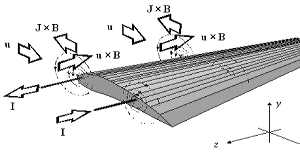
In the figure, the basic concept of the MHD interaction for the control of flow regime in the boundary layer of an hypersonic vehicle is shown. The current I flowing in the conductor located under the leading edge of the body generates a magnetic flux density which, interacting with the gas flowing with velocity u, produces an electromotive force uxB . If the gas presents some ionization degree, the electromotive force generates a current density J which, interacting with the magnetic flux density, originates a body force J xB on the gas, opposite to the flow direction. |
|
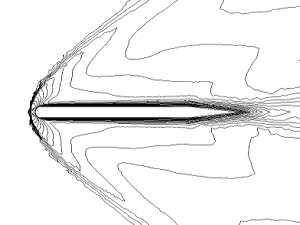
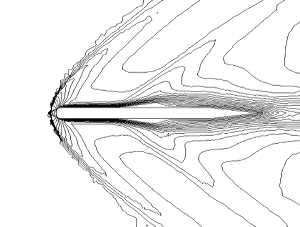
The deflection of the flow and the reduction of the air speed caused by the specific force JxB generates a pressure rise in the region immediately ahead the conductors. The integrals of the forces along the y-direction due to the wall pressure, does not change when the MHD interaction is active. Thus, the negative variation of pressure is equal to the positive one. This means that a torque is generated on the flying body by the MHD interaction, with no additional airlift.
Mach-isolines without and with the Mhd interaction. The conductors are placed in the head and in the middle of the airfoil.
At the same time of the numerical investigation, we are also engaged with an experimental work on the same arguments granted from ESA (European Space Agency) and ASI (Italian Space Agency). All the experiments are performed in Alta laboratories in Pisa, where it was setted up an hypersonic wind tunnel.
Go to the MHD interacion gallery .