|
A
large effort is spent by the international community in the research on
controlled thermonuclear fusion (CTF) with magnetic confinement machines.
The main activity is concerned with Tokamak machines. A lot of
experimental facilities are present in the world; in Europe the main
facility is JET (Joint European Torus) where models and technologies
have been tested and knowledge was obtained for the design of the next
experiment.
|
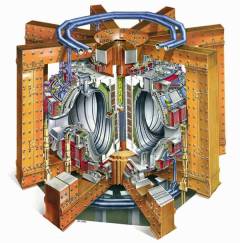
frame of JET
|
|
The
new experiment, named ITER (International Tokamak Experimental Reactor),
has been developed till to now by means of a joint effort of Europe,
Japan, Russia and United States. After a long design phase the final
phase of site decision is arrived.
The
main goal of the experiment is the demonstration of the feasibility of
the controlled thermonuclear fusion technology to produce energy for
civil use.
|
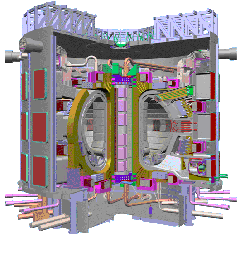
frame
of ITER
|
In
all the magnetic confined plasma machines, the magnets which have to produce
the magnetic field for the confinement, stability and heating of plasma are
realized by means of superconducting cables, otherwise the required energy to
produce such a large magnetic fields on such a large volumes will be too high
for the technology to be feasible. Usually Cable in Conduit Conductor (CICC)
are utilized , with strand realized by means of
NbTi or Nb3Sn, stabilized with copper. In order to obtain a
good performance of the magnets, which
operate in pulsed regime, it is necessary to reduce as much as possible a.c.
losses in the cable and to avoid to reach quench conditions, when transition
from superconducting state to
normal state of the cable happens. If such an event occurs machine must be
stopped as soon as possible in order to avoid permanent damage of itself. It
is thus very important to be able to simulate the magnets behaviour in the
pulsed regime in the design phase.
A lot of
phenomena must be considered when modelling superconducting magnets for FTC.
The electro-magnetic phenomena which are responsible of transport current
distribution among the strands of the cable and of a.c. losses in the cable
sectors must be taken into
account. Also the electromagnetic phenomena which are concerned with current
distribution in the terminations and joints between cable sectors of the coil
have an important role and must be included in the model. Finally the
thermo-hydraulic phenomena which are responsible of temperature distribution
of solid bodies and temperature, velocity and pressure distribution of Helium
in the superconducting cable needs to be taken into account. The
electromagnetic phenomena end the thermohydraulic phenomena are strongly
coupled each other due to the temperature dependence of the electric field vs.
current density curve of the superconducting and stabilizer materials.
Since
year 2000 the Applied Superconductivity Laboratory is involved in a reasearch
program which is supported and coordinated by the European Fusion Development
Agreement (EFDA) (www.efda.org), with the main goal of the development of code THELMA
for the calculation of current distribution, a.c. losses, helium temperature,
velocity and pressure distributions in the superconducting coils which are of
interest for the nuclear fusion applications. Code THELMA allows the complete
description of a superconducting
coil by simultaneous solution of the equation of the electromagnetic models of
the cable-sectors, of the cable terminations and joints, and of the
thermohydraulic model of helium and of the thermal model of all solid bodies.
The
electromagnetic model of the cable-sector is based on a distributed parameters
circuit approach and has been developed by the Department of Electrical
Engineering of the University of Bologna. The electromagnetic model of the
cable-terminations and joints between cable-sectors is based on a lumped
parameters circuit approach, as much as current distribution in the
superconducting cable is concerned, and on a finite element approach as much
as current density distribution in the solid normal material of joints/terminations
is concerned; the model has been developed by the Department of Electrical,
Mechanical and Management Engineering of the University of Udine (www.uniud.it).
The thermo-hydraulic model of helium flow and the thermal model of all the
solid bodies have been developed by the Department of Energetics of
Politecnico of Torino (www.polito.it).
The
research activity is coordinated by the EFDA Close Support Unit in Garching
and from the Superconductivity Division of the Research Center of ENEA in
Frascati (www.frascati.enea.it).
A contribution is given from the Applied Superconductivity Center of the
University of Twente, as much as the experimental validation of the code is
concerned. The THELMA code is now in the validation phase.
References:
1.
P.L. Ribani, “CDCABLE. A code to calcolate current distribution in superconducting
multi-filamentary cables”, TASK N. TW0-T400-1/01 Deliverable N.8, Report of
University of Bologna, May, 2002
2.
M. Breschi, P.L. Ribani, “Measurements of self and mutual induction
coefficients of the strands of a multi-strand multi-stage cable and comparison
with numerical results”, TASK N. TW1-TMC-CODES, Design and interpretation
codes, Report of University of Bologna, October 2002.