|
The following types of machines are
currently taken into accounts:
-
induction machines
-
brushless synchronous machines
-
wound excited synchronous machines
For this activity are available
three benches, that are quite similar for structure and devices.
A basic scheme for the bench is reported in the following figure.
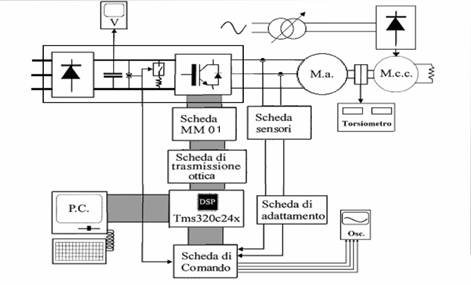
Basic scheme for the electric drive of each bench
|
On
these benches the main
activity is the development
of Assembler source for DSP TMS320F240 e TMS320F2407A. These
DSP are mounted on dedicated Evaluation Boards
together with the peripherals that are necessary for programming,
acquiring and generating the output signals for the inverter that
feeds the
motor. |
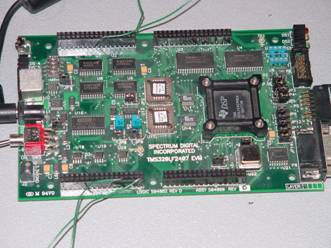
Evaluation Board for TMS320F2407A |
The
implementation of the control algorithm with
low-level languages has the aim to develope software with high performance
with regards to the execution speed, that could not be achieved with more
sophisticate languages (C, C++, Matlab)..
|
Output signals for driving
the switches of the inverter are sent to the power stage by using
optical fibres.
Data acquisition of voltage
and currents are performed using Hall effect sensors and signal
conditioning circuits. |
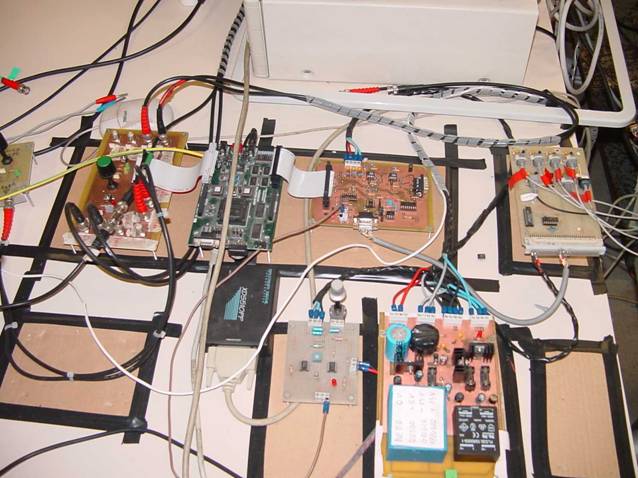
Additional board and sensors |
|
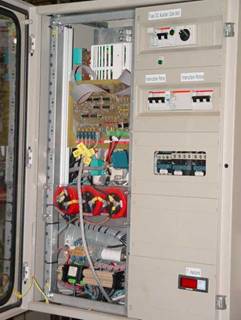
Inverter for motor control |
The power stages of the
inverters have been realized in our laboratory, by using state of the art
technology. Between control board and power stage is installed a board
which manages the firing signals of the IGBTs and guarantees the safe
operation of the power stage.
The motor under development is
installed on a test bench. A brake machine, and a torque and speed
measurement system are connected at the shaft of the motor. |
|
