Strands and cables
|
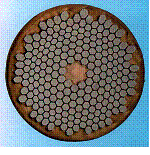
The cables used for superconducting magnets in high field
applications are made of a number of strands wound in different cabling stages
with different twist pitches. The strands made of a very high number of
superconducting filaments (typically from some hundreds to some thousands)
embedded in a normal metal matrix. The filament diameters are in the range of
microns, while the typical strand diameters are around one millimeter. |
Superconducting Strand
|
|||
|
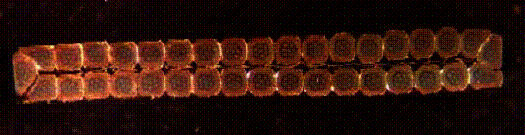
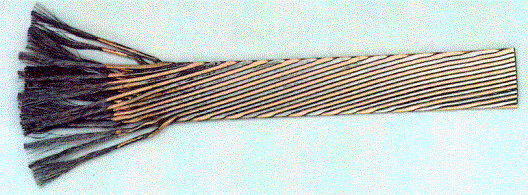
In flat Rutherford cables, used for particle
accelerator magnets, the strands are wound with a given transposition pitch
and deformed to have a rectangular cross section (see the picture below). The
refrigeration is obtained by means of a direct contact with liquid helium.
Rutherford cable |
||||
|
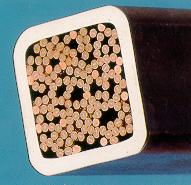
In the Cable in Conduit Conductors (CICC) used for the controlled thermonuclear fusion, the strands are wound in different winding stages and extruded in a jacket, made of either aluminum or stainless steel. The liquid helium flows in forced convection inside the jacket, wetting the superconducitng strands. Both in Rutherford cables and in Cable in Conduit Conductors the strands are transposed in order to reduce the ac losses during field or current ramps. The transposition is however incomplete, mainly when high longitudinal field gradients are applied to the cable. Therefore, in the presence of current or field ramps, necessary for the operation of both accelerator and fusion magnets, induced currents are generated. |
CIC Conductor for fusion |
|||
|
The superposition of induced currents to the transport current and the resistive effects due to different contact resistances of the strands at the cable joints, generate a non uniform current distribution between the different cable strands. This phenomenon can cause a transition of the superconducting cable to the normal state (quench), before the total critical current of the cable has been reached. This phenomenon is called “ramp rate limitation”, being particularly relevant during current ramps. A further undesired effect of non uniform current distributions is the distorsion of the magnetic field generated by the cable. These field errors have to be predicted and corrected for a good operation of particle accelerators.
The study of the electrodynamics of superconducting
magnets is therefore a necessary condition for an accurate design of the
magnet themselves. Several models have been prepared for this study. "Transmission
line model"
·
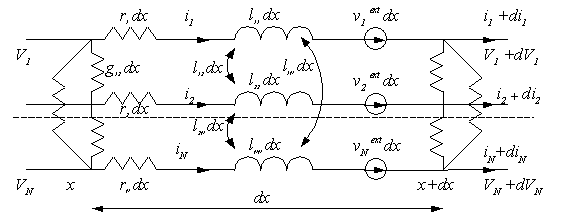
Thie distributed parameters electrical circuit is
similar to the models used for the analysis of transmission lines ·
This model, through a remarkable reduction of the
number of unknowns with respect to the lumped parameter models usually emplyed,
allows to study current distribution in real cables made of some tens of
strands used to wind superconducting magnets. It has been particularly adapted
to the geometry of Rutherford cables. ·
The effects of the 3D geometry of the cables and
magnets is taken into account in the calculation of the electrical parameters
of the model.
Electromagnetic
and thermo-hydraulic model THELMA ·
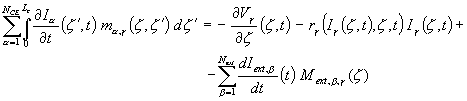
Another 1-D distributed
parameter circuit model has been developed to keep into account the inductive
coupling between strand sectors that placed far along the cable. The
model equations have been derived by the Maxwell equations, and allow the
study of a complete winding or of a set of different windings:
·
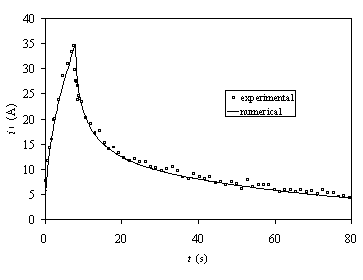
This model has been developed in the frame of the
research activities regarding the magnets for controlled
thermonuclear fusion and is coupled with a thermo-hydraulic description of
the liquid helium flowing in the Cable in Conduit Conductors. |
||||